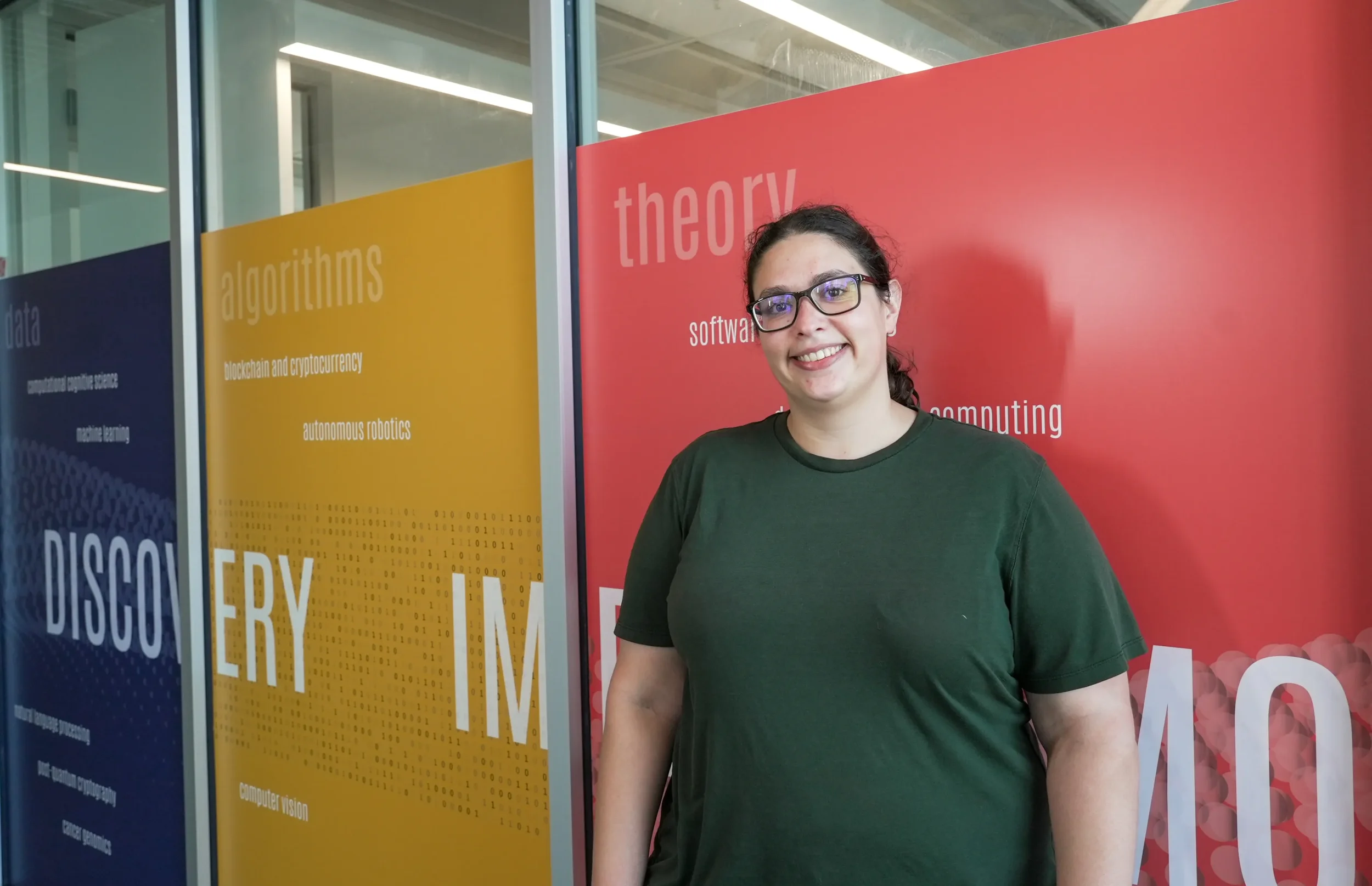

Assistant Professor of Information and Government and Politics
Julia Mendelsohn
University of Maryland
Areas of Expertise: Natural Language Processing and Political Communication
Julia Mendelsohn is an assistant professor in the College of Information with an appointment in the University of Maryland Institute for Advanced Computer Studies. Working at the intersection of natural language processing, political communication, sociolinguistics and psychology, her research uses computational methods to model subtle rhetoric in online political discussions and examine the social, political and technological impacts of digital discourse.
-
J. Ashkinaze, J. Mendelsohn, L. Qiwei, C. Budak, E. Gilbert (2025). Proceedings of the ACM Collective Intelligence Conference, pgs. 198-213
Abstract: Exposure to large language model output is rapidly increasing. How will seeing AI-generated ideas affect human ideas? We conducted a dynamic experiment (800+ participants, 40+ countries) where participants viewed creative ideas that were from ChatGPT or prior experimental participants, and then brainstormed their own idea. We varied the number of AI-generated examples (none, low, or high exposure) and if the examples were labeled as “AI” (disclosure). We find that high AI exposure (but not low AI exposure) did not affect the creativity of individual ideas but did increase the average amount and rate of change of collective idea diversity. AI made ideas different, not better. There were no main effects of disclosure. We also found that self-reported creative people were less influenced by knowing an idea was from AI and that participants may knowingly adopt AI ideas when the task is difficult. Our findings suggest that introducing AI ideas may increase collective diversity but not individual creativity.
-
J. Mendelsohn & C. Budak (2025). Proceedings of the 63rd Annual Meeting of the Association for Computational Linguistics (Volume 1: Long Papers), pgs. 8079-8103
Abstract: Metaphor, discussing one concept in terms of another, is abundant in politics and can shape how people understand important issues. We develop a computational approach to measure metaphorical language, focusing on immigration discourse on social media. Grounded in qualitative social science research, we identify seven concepts evoked in immigration discourse (eg water or vermin). We propose and evaluate a novel technique that leverages both word-level and document-level signals to measure metaphor with respect to these concepts. We then study the relationship between metaphor, political ideology, and user engagement in 400K US tweets about immigration. While conservatives tend to use dehumanizing metaphors more than liberals, this effect varies widely across concepts. Moreover, creature-related metaphor is associated with more retweets, especially for liberal authors. Our work highlights the potential for computational methods to complement qualitative approaches in understanding subtle and implicit language in political discourse.
-
J. Mendelsohn (2024). Michigan Publishing
Abstract: Framing, emphasizing certain aspects of an issue to promote particular interpretations, can affect public opinion, policy preferences, and social movement mobilization. Although ordinary people increasingly consume and share political content on social media, little is known about how they frame political issues and are affected by framing on social media. Throughout my dissertation, I develop theoretically-grounded computational approaches to analyze political framing on Twitter, with a particular focus on immigration. I first draw from political communication theory to understand the public's production and reception of frames in immigration discourse on Twitter. I develop a codebook, annotated dataset, and NLP models to automatically detect framing strategies across three different typologies, and highlight tradeoffs between issue-generic and issue-specific typologies. Then turning towards social movements, I adopt a similar computational pipeline to study how movements engage in framing practices to create meaning and mobilize collective action. Finally, I develop and evaluate LLM-based approaches to detect dehumanizing metaphors about immigrants, which I use to study the nuanced relationship between metaphorical framing and political ideology. Throughout my dissertation, I emphasize the value of incorporating social science theories into computational research and conversely the utility of computational methods to address social science research questions.